

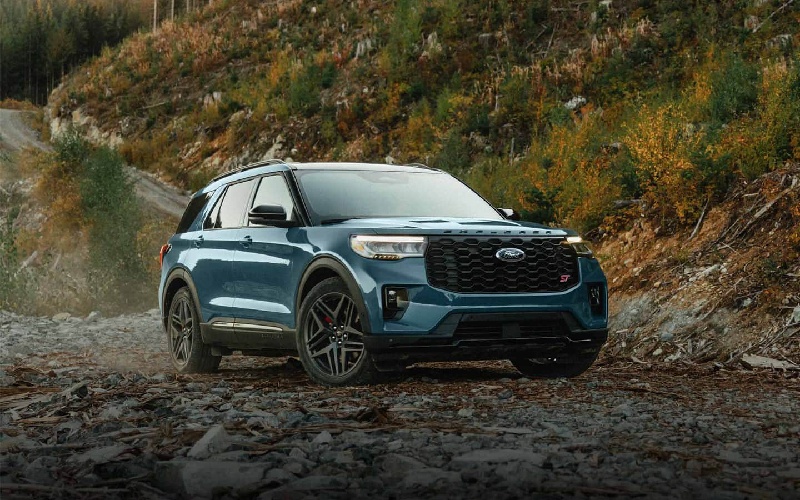
Hastings Ford – Does BlueCruise make the 2025 Ford Explorer a smarter family SUV than the Honda Pilot near Grand Island, NE?
When families compare two capable three-row SUVs, a common question emerges: which one reduces driver fatigue the most on real highways? The conversation inevitably turns to highway driver-assist tech—specifically, Ford’s available BlueCruise for the 2025 Ford Explorer versus the driver-assist suite on the 2025 Honda Pilot. Both models include helpful features like adaptive cruise control and lane support, but only the Explorer offers hands-free highway driving in designated Blue Zones when conditions allow. That difference can translate into a calmer, more consistent commute and more relaxed road trips without sacrificing your attention to the road. Below, we break down what BlueCruise is, how it compares to the Pilot’s systems, and the practical advantages families notice after a few weeks of ownership.
BlueCruise builds on Ford Co-Pilot360® Assist+ technologies by combining forward-facing cameras, radar, and high-precision maps to enable hands-free driving on approved divided highways—what Ford calls Hands-Free Blue Zones. You continue to watch the road while the system manages steering, braking, and acceleration within its operational boundaries. The Honda Pilot’s Honda Sensing® suite is robust, with Adaptive Cruise Control, Lane Keeping Assist System, and Road Departure Mitigation, and top trims add features like a Head-Up Display and a multi-view camera system. However, the Pilot does not offer a true hands-free highway system at this time, which means drivers must keep their hands on the wheel during assisted driving. For many families shuttling between practices, errands, and interstate trips, the Explorer’s hands-free capability becomes a meaningful benefit day after day.
- Driver involvement: BlueCruise enables hands-free operation in mapped zones; Honda Sensing® requires hands-on steering during assistance.
- Confidence on trips: The Explorer’s available 360-degree camera and lane-centering complement BlueCruise for merging, lane discipline, and low-speed maneuvering.
- Towing readiness: Every 2025 Explorer includes a Class III Trailer Tow Package; Pilot requires specific trims or accessories for equivalent hardware.
- Powertrain character: The Explorer’s turbocharged EcoBoost® approach emphasizes low-rpm torque; Pilot’s V6 offers smooth, naturally aspirated response.
- Design flexibility: Explorer ST-Line and ST offer available 21-inch wheels and an available black-painted roof; Pilot tops out at 20-inch wheels and does not offer a factory black roof.
Frequently Asked Questions:
What is BlueCruise, and where does it work?
BlueCruise is Ford’s available hands-free highway driving system that operates on prequalified, mapped divided highways called Hands-Free Blue Zones. You must remain attentive, but the system can manage steering, acceleration, and braking while keeping you centered and following traffic flow.
How does the Pilot’s highway assistance differ?
Honda Sensing® provides helpful lane keeping and adaptive cruise functions, but it does not support hands-free operation. Drivers must keep hands on the wheel during assisted driving.
Does BlueCruise help with stop-and-go traffic?
When combined with Adaptive Cruise Control with Stop-and-Go and Lane-Centering, the Explorer can assist through congestion on approved highways, easing the start-stop fatigue common on busy commutes.
Is towing supported by these driver-assist features?
Driver-assist features are supplemental and may have limitations when towing, but hardware readiness is a clear Explorer advantage—every 2025 Explorer ships with a Class III Trailer Tow Package, while the Pilot requires specific trims or accessories.
Which SUV feels more composed on the highway?
Subjectively, many drivers report the Explorer’s rear-wheel-drive foundation (with available 4WD) contributes to a planted, confident feel, especially when changing lanes or merging. We recommend test driving both on the same route to evaluate steering, acceleration, and ride comfort.
Ultimately, the best choice comes from seat time. Take the same highway stretch, try merging and passing maneuvers, and simulate your daily commute. Bring a full crew to check third-row access and cargo flexibility, and ask to demo parking aids and camera views in a crowded lot. If hands-free capability and towing-ready hardware are high on your list, the 2025 Ford Explorer holds a distinct advantage. If you value off-pavement features like TrailWatch™ on the Pilot, make sure to evaluate the trims that include it. Either way, a structured test plan makes differences easy to feel and remember when it’s time to decide.
Our team will be happy to map a route that includes city streets and divided highways, explain how BlueCruise fits into Ford Co-Pilot360® Assist+, and review system boundaries so you can use driver-assist features confidently and correctly. For a live walkthrough that fits your family’s needs, contact Hastings Ford, serving Juniata, Grand Island, and Aurora.
Request more 2025 Ford Explorer information
Connect with us

