

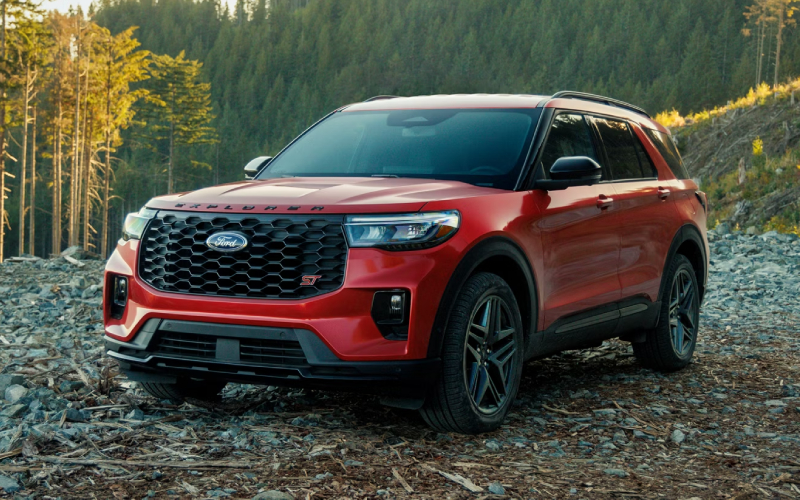
Hastings Ford – Is All-Wheel Drive Worth It on a 2026 Ford Explorer for Families around Aurora, NE?
Choosing the right drivetrain is one of the most important decisions you will make on a three-row SUV. With the 2026 Ford Explorer, rear-wheel drive comes standard for balanced handling, while all-wheel drive is available across the lineup. If you regularly see snow, rain, or unpaved roads, understanding the real-world differences helps you decide whether AWD belongs on your short list around Aurora, NE.
The Explorer’s standard turbocharged 2.3-liter four-cylinder (300 horsepower, 310 lb-ft of torque) and 10-speed automatic are refined and responsive in either configuration. With all-wheel drive, you add traction that helps you launch confidently on slick surfaces, climb gravel inclines more smoothly, and maintain poise when the weather turns. Drivers who value maximum performance will be drawn to the ST’s twin-turbocharged 3.0-liter V6 (400 horsepower, 415 lb-ft), which pairs with AWD for a seriously quick yet well-mannered family SUV. In both cases, the Explorer retains composed ride and predictable handling, the kind of behavior you appreciate on I-80 or a winding county road.
- Winter traction: AWD helps the Explorer accelerate more cleanly on packed snow, reducing wheelspin and increasing driver confidence.
- Gravel and dirt stability: With AWD, power distribution improves grip when the road surface is loose or uneven.
- Towing confidence: The Explorer’s 5,000-pound max rating benefits from AWD when launching on ramps or wet boat launches.
- Daily drivability: AWD complements the Explorer’s standard driver-assist tech to help keep you composed in changing conditions.
Inside, every 2026 Explorer features a 13.2-inch LCD touchscreen and the Ford Digital Experience with access to select Google and Amazon apps, plus Apple CarPlay and Android Auto. When parked, you can stream YouTube, browse, and even play via Google Play. Most trims include a 12-speaker Bang & Olufsen audio system, and the cabin offers eight USB ports, including two in the third row. Available driver-assist upgrades such as self-parking assist and the option to add BlueCruise on select trims complement AWD by reducing fatigue on longer drives.
If you are evaluating AWD for occasional off-pavement driving, the new Tremor model adds hardware focused on traction and clearance: a lifted suspension, limited-slip rear differential, special 18-inch wheels, and all-terrain tires. Tremor is designed for uneven terrain and muddy trailheads where grip and approach angles matter, while maintaining the Explorer’s family-friendly manners on paved roads. Together with the standard Class III towing package and trailer sway control, the Explorer lineup offers a wide range of confidence-boosting setups for Nebraska use cases.
Frequently Asked Questions:
Does AWD change the Explorer’s towing rating?
The Explorer is rated to tow up to 5,000 pounds, and that maximum remains the same when you choose all-wheel drive. AWD can help you launch more smoothly on slick ramps and maintain traction on gravel.
Is AWD available on non-ST models?
Yes. All-wheel drive is available across the lineup. Rear-wheel drive remains standard, giving you the flexibility to choose based on local conditions and personal preference.
For many Aurora-area families, AWD is worth it for the added assurance when winter weather hits or when weekend plans include gravel drives and trailheads. If your routes are primarily paved and you rarely see snow, the standard rear-wheel-drive setup might suit you just fine. We recommend driving both back-to-back to appreciate the nuanced difference in traction and feel.
Hastings Ford is proud to support shoppers serving Grand Island, Aurora, and Kearney with side-by-side test drives and clear guidance on drivetrain, towing, and technology. Tell us about your roads and routines, and we will set up a route that mirrors your everyday driving so your decision is simple and confident.
Request more 2026 Ford Explorer information
Connect with us

